
Whether you are buying flooring, ordering paint, planning furniture, or listing a property, you first need to know how big the space is. This free room size calculator finds the square footage of any room in seconds. Enter the length and width, and it returns the floor area instantly. You can even add multiple rooms to total the square footage of a whole house.
This guide from Anchor AI Tools includes a built-in room area calculator, the simple formula behind it, worked examples for rectangular and irregular rooms, a quick-reference size chart, and answers to the questions people ask most when they calculate room square footage.
Quick answer: To find the size of a room in square feet, multiply its length by its width. For a room that is 12 ft long and 10 ft wide, the area is 12 × 10 = 120 square feet.
For an L-shaped or irregular room, split it into rectangles, calculate each one, and add the results together.
Enter the length and width of each room below. The calculator returns the square footage per room and the combined total, handy when you need to measure several rooms at once, such as a whole apartment or floor. Choose your unit and the tool converts everything to square feet for you.
📐 Room Size Calculator
Add one or more rooms. Results update in square feet, square meters and square yards. Nothing is uploaded or stored.
Once you know the area, head to the main square footage calculator for more shapes and options, or use the result directly with our concrete calculator for slabs and floors.
The square footage of a standard rectangular room is the product of two measurements: length and width. This is the same area formula used across construction, real estate, and interior design.
If you measured in inches, divide each measurement by 12 to convert to feet first, or divide the final result by 144, since there are 12 × 12 = 144 square inches in a square foot. If you measured in meters, the area comes out in square meters, so multiply by 10.764 to convert to square feet.
The room size calculator above handles all of these conversions automatically, so you can enter measurements in whatever unit your tape measure shows.

Measure length and width at floor level, then multiply to find the room's square footage.
Not every room is a clean rectangle. For an L-shaped living room, a room with an alcove, or an open-plan space, the trick is to break the floor plan into smaller rectangles, find the area of each, and add them together.
Say your living area is an L-shape: one section measures 12 ft × 10 ft (120 sq ft) and the smaller leg measures 6 ft × 5 ft (30 sq ft). The total room square footage is 120 + 30 = 150 square feet. The calculator above supports this directly, so just add each rectangle as a separate room and read the combined total.
For circular or triangular spaces the area formula changes, since a circle is π × radius² and a triangle is ½ × base × height, but the principle stays the same: calculate each shape, then sum the areas. For multi-room totals across a property, the floor plan square footage calculator is purpose-built for whole layouts.
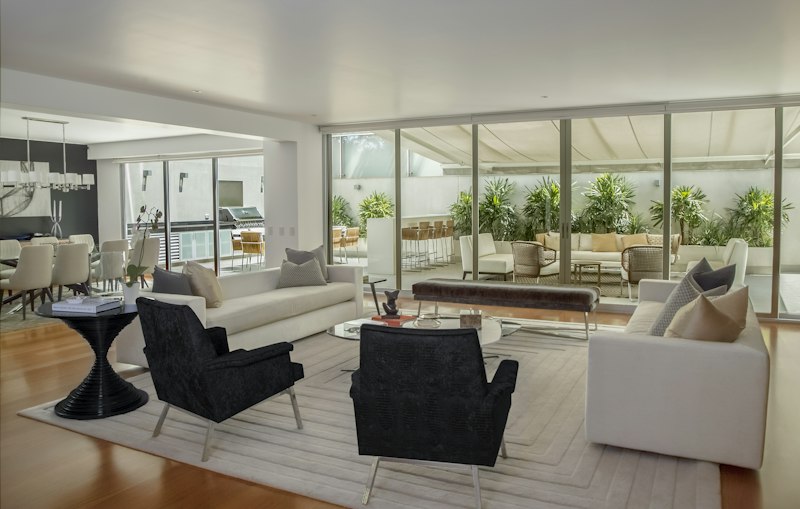
Break an L-shaped or irregular room into rectangles, then add each area for the total square footage.
Use this reference to sanity-check your measurements. These are typical floor areas for rooms in homes across the US, useful when estimating before you measure, or when comparing a room to the average.
| Room | Typical size (ft) | Square feet | Square meters |
|---|---|---|---|
| Small bedroom | 10 × 10 | 100 | 9.3 |
| Standard bedroom | 12 × 11 | 132 | 12.3 |
| Master bedroom | 14 × 16 | 224 | 20.8 |
| Bathroom | 5 × 8 | 40 | 3.7 |
| Kitchen | 12 × 12 | 144 | 13.4 |
| Living room | 16 × 18 | 288 | 26.8 |
| Dining room | 12 × 14 | 168 | 15.6 |
| Two-car garage | 20 × 20 | 400 | 37.2 |
Pro tip: these are averages, not rules. Always measure your own space, because even a few inches of difference adds up when you are ordering flooring or paint by the square foot.
📋 Example 1 · a rectangular bedroom
You are carpeting a bedroom that measures 13 ft long by 11 ft wide.
Calculation: 13 × 11 = 143 square feet
🏠 Example 2 · a whole apartment
| Room | Dimensions | Square feet |
|---|---|---|
| Living room | 16 × 14 | 224 |
| Bedroom | 12 × 11 | 132 |
| Kitchen | 10 × 9 | 90 |
| Bathroom | 6 × 8 | 48 |
| Total | 4 rooms | 494 |
📐 Example 3 · inches instead of feet
A small office measures 138 inches by 120 inches.
Convert: 138 ÷ 12 = 11.5 ft, and 120 ÷ 12 = 10 ft, so 11.5 × 10 = 115 sq ft
Knowing a room's size in square feet is the starting point for dozens of everyday tasks. Homeowners use it to budget for flooring, carpet, tile, and laminate, which are all sold by the square foot. Painters use it to estimate how much paint a job needs. Real estate agents and renters compare listings by total living area, and HVAC technicians size heating and cooling systems based on the square footage of each room.
Interior designers and furniture shoppers rely on room dimensions to make sure a sofa or bed will fit. If your project involves a slab or subfloor, send your figure straight to the concrete calculator. Painting instead? The wall square footage calculator turns the same room into paintable wall area and gallons of paint.
Measure at floor level. Walls are not always perfectly straight, and baseboards can throw off a reading taken higher up. Measure where the floor meets the wall.
Round up when buying materials. Add roughly 5 to 10% to your room square footage to account for cutting waste, pattern matching, and mistakes when ordering flooring or tile.
Exclude permanent fixtures only when needed. For flooring, subtract the footprint of kitchen islands or built-in cabinets. For paint and total living area, you usually include the full floor area.
Double-check your arithmetic. Manual multiplication is easy to fumble. Run your numbers through the calculator above to confirm before you buy.
Need to measure more than one room or a whole house?
Open the Floor Plan Calculator →Square Footage Calculator
Measure rooms, flooring, and land area in any shape.
Floor Plan Square Footage
Add every room into one total floor area.
Wall Square Footage
Paintable wall area and gallons of paint.
Price Per Square Foot
Work out cost per square foot for any area.
Sq Ft to Sq Meters
Convert any area to metric instantly.
Concrete Calculator
Cubic yards for slabs, footings, and floors.
Percentage Calculator
Work out cost shares, waste, and discounts.
How to Measure a House
The five-step room-by-room method.

The room chart and all three worked examples on this page are re-derived in both square feet and square meters before publishing · How we check our tools
This tool is for planning only. Confirm critical measurements before buying materials.
Written by Amara Taylor for Anchor AI Tools · Last reviewed September 13, 2026 · © 2026 Anchor AI Tools